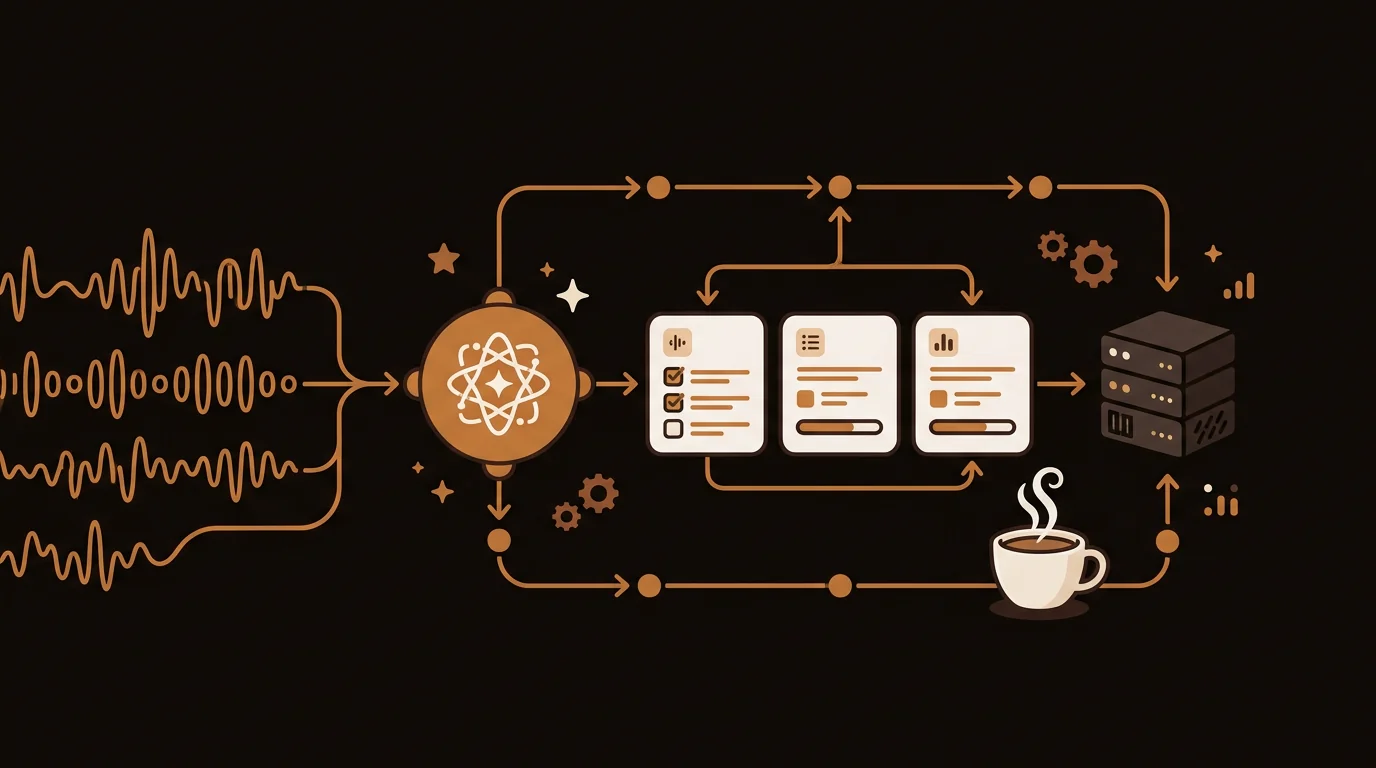
At sipsip.ai, I've spent the last year building the pipeline that turns a YouTube URL into a structured summary in under two minutes. The technology behind it isn't magic — it's a set of well-established components combined in a way that handles the edge cases most tools get wrong. Here's how it actually works.
What an AI Video Summarizer Actually Does
The term 'AI video summarizer' describes a pipeline, not a single model. When you paste a YouTube URL into a tool like sipsip.ai's Transcriber, at least three distinct processing steps happen before you see any output: audio extraction, speech-to-text transcription, and language model summarization. Each step has its own failure modes, and the quality of the final summary depends on how well the system handles all three.
Step 1: Audio Extraction and Preprocessing
The first step is getting the audio out of the video. For YouTube content, this means retrieving the audio stream without downloading the full video file. The audio is then preprocessed — resampled to a standard frequency (typically 16kHz for ASR models), converted to mono, and optionally noise-reduced.
This step matters more than it sounds. Variable audio quality across YouTube videos — background music, compression artifacts, multiple simultaneous speakers — affects downstream transcription accuracy significantly. Tools that skip preprocessing tend to produce worse transcripts on low-quality source audio.
Step 2: Automatic Speech Recognition (ASR)
ASR is where audio becomes text. The dominant approach today uses transformer-based models fine-tuned on large speech corpora. OpenAI's Whisper is the most widely used open-source model — trained on 680,000 hours of multilingual audio, it handles diverse accents, domain-specific vocabulary, and code-switching reasonably well.
At sipsip.ai, we run Whisper with speaker diarization enabled for multi-speaker content. Diarization segments the transcript by speaker, which significantly improves readability for interview-style content and makes the downstream summarization more accurate — the model can reason about what the host asked versus what the guest answered.
Step 3: Transcript Cleaning and Chunking
Raw ASR output contains disfluencies: filler words ('um', 'uh'), false starts, run-on sentences without punctuation. A language model pass cleans this up and adds proper punctuation and paragraph breaks. This is computationally cheap but has a large impact on the quality of both the readable transcript and the downstream summary.
After cleaning, the transcript is chunked for summarization. Most LLMs have context window limits, and a 2-hour video transcript can easily exceed 100,000 tokens. The chunking strategy matters: naive fixed-size chunks break mid-argument. We use semantic chunking — splitting at natural topic boundaries using sentence similarity — which preserves the logical structure of the content.
Step 4: LLM Summarization
The cleaned, chunked transcript goes to a large language model with a summarization prompt. The prompt engineering here has a significant effect on output quality: a poorly designed prompt produces a recitation of the transcript's surface content; a well-designed one extracts the actual arguments, identifies key claims, and structures output in a way that's useful for the reader.
For long videos, we use a map-reduce approach: summarize each chunk independently, then synthesize the chunk summaries into a final output. This scales to arbitrary video length without quality degradation from context overflow. The final output is structured — key points, main arguments, notable quotes, and a concise abstract — which is what appears in the sipsip.ai daily brief.
Why Quality Varies So Much Between Tools
Most AI video summarizer tools use the same underlying models. The differences in quality come from: (1) how well they handle preprocessing edge cases, (2) their chunking strategy for long content, (3) prompt design for the summarization step, and (4) how they handle multi-speaker content. In our testing at sipsip.ai, the biggest single quality improvement came from switching to semantic chunking — summaries became significantly more coherent because the model was summarizing complete arguments rather than arbitrary text windows.
Related Article
How to Get a YouTube Transcript (3 Free Methods for 2026)
What This Means for Users
Understanding the pipeline helps you use these tools better. If a summary seems to miss important points from the end of a video, the tool may be hitting context limits. If the transcript is accurate but the summary is generic, the prompt engineering is the weak link. If multi-speaker content is garbled, speaker diarization isn't being applied. For most use cases — extracting key points from conference talks, summarizing podcast episodes, reviewing competitor demos — a well-built summarizer running on Whisper and a capable LLM will get you 80–90% of what a human would extract, in a fraction of the time.
Frequently Asked Questions
What model does sipsip.ai use for transcription?
We use OpenAI Whisper for speech-to-text. For summarization, we use a combination of models depending on content length and type. The architecture is designed to be model-agnostic at the summarization layer — we update as better options become available.
How accurate is AI transcription on technical content?
Accuracy on technical content varies by domain. Whisper handles general technical vocabulary well — software engineering and product terminology are well-represented in its training data. In our testing across tech conference talks and founder interviews, word error rate is typically under 5% for clear audio.
Can AI video summarizers handle non-English content?
Whisper supports 50+ languages with varying accuracy. High-resource languages (Spanish, French, German, Japanese, Chinese) perform close to English. The summarization step works in any language the underlying LLM supports.
How long does it take to summarize a 1-hour video?
At sipsip.ai, a 1-hour video takes approximately 90–120 seconds end-to-end: 30–40 seconds for audio extraction and ASR, then 30–60 seconds for the LLM summarization pass depending on content length.
Does summarization work better for some types of content?
Yes. Structured content — lectures, presentations, interviews with clear turn-taking — summarizes better than unstructured content. Talks where the speaker explicitly states their main points produce higher-quality summaries because the signal is already concentrated in the audio.

Building systems and infrastructure that work reliably in production.